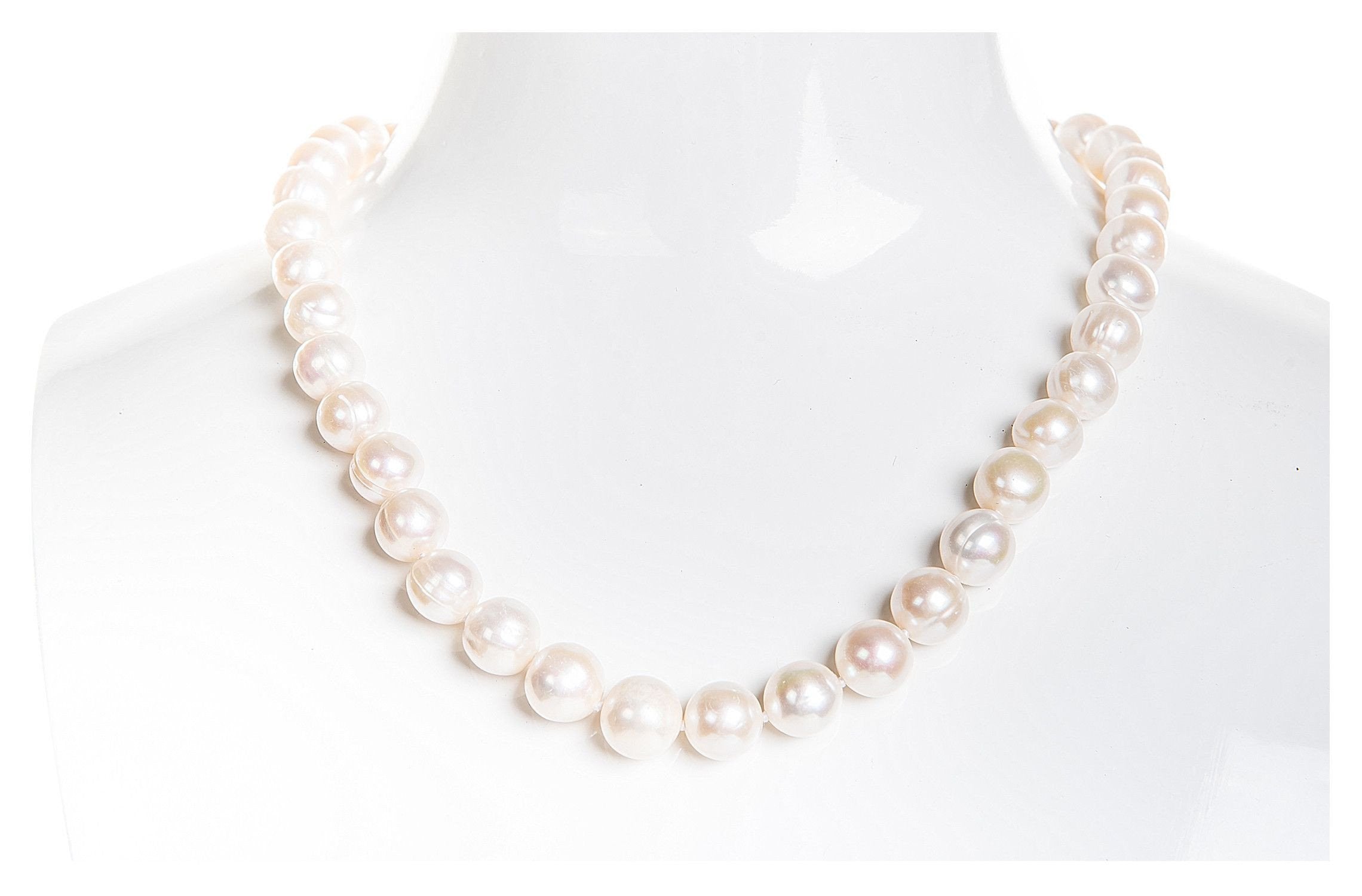
Inherited strands and flea-market finds raise the same question: are these real? There is no single foolproof test you can do standing at a kitchen counter, but there are five that, used together, will tell you almost everything you need to know.
The tooth test
Rub the pearl gently against the edge of your front tooth. A genuine pearl, cultured or natural, feels slightly gritty because you are feeling the layered aragonite platelets of nacre. A glass or plastic imitation feels smooth, almost slick, because there's no crystalline structure to catch on. This is the fastest test and the one most people reach for first, but it has a real limitation: shell-based imitations (pearls coated with ground mother-of-pearl paste, sometimes called "majorica" style) can feel slightly textured too, since the coating itself contains shell material. It's a good first filter, not a final verdict.
Drill-hole inspection
This is where a jeweler's loupe (10x is plenty) earns its keep. Look straight into the drill hole. On a genuine cultured pearl you'll usually see the nacre layer as a slightly different color or texture ring around the edge of the hole, sometimes with a visible bead nucleus at the center if it's a saltwater pearl. On an imitation, the hole often shows a painted or coated interior, and you can sometimes see the coating starting to flake or chip at the hole's edge, especially on older costume pieces. This is, in our view, the most reliable test of the bunch for anyone without lab equipment, because it's looking at physical structure rather than a surface feel or a subjective reaction. Combine it with the tooth test and you've covered both texture and structure.
Temperature
Pick the pearl up. A real pearl feels cool against your skin for the first few seconds, then warms to body temperature the way stone does. Plastic warms almost instantly because it's a poor conductor of heat retention in the opposite way people expect — it just doesn't hold that initial coolness. This test is quick but easy to fool yourself on if the pearl has been sitting in a warm room or your pocket. Don't rely on it alone.
Weight
Cultured freshwater pearls have real heft for their size because nacre is dense. Roll a few loose pearls in your palm. Glass imitations can actually feel heavier (glass is dense too), while hollow plastic ones feel obviously light. Weight is more useful for ruling out cheap plastic than for confirming something is a fine pearl — a heavy bead doesn't prove authenticity, it just narrows the field.
Uniformity
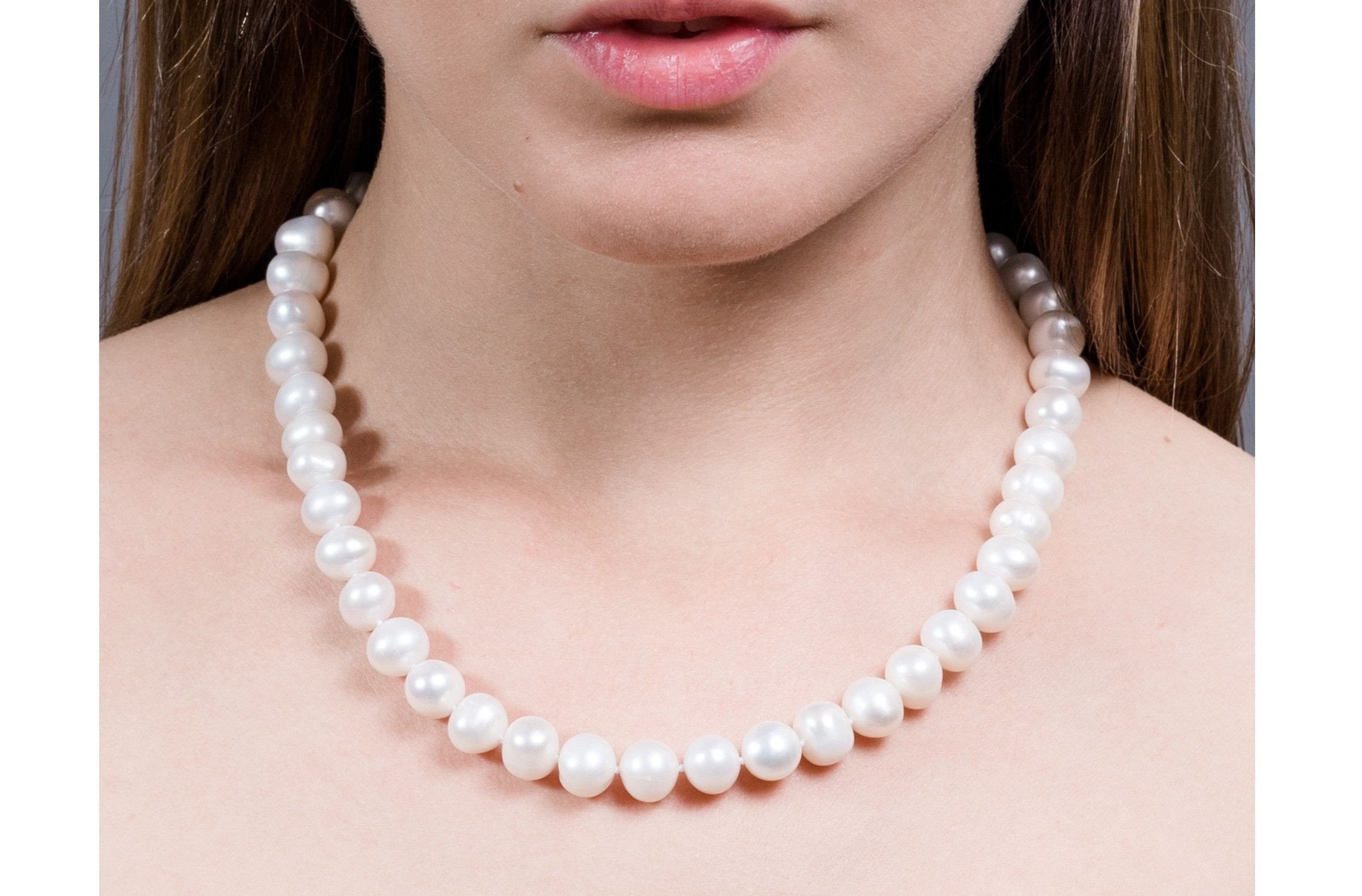
Look down the length of a strand. Genuine cultured pearls, especially freshwater ones, are rarely perfectly identical. You'll see small variations in shape, minor surface marks, subtle color shifts pearl to pearl. A strand where every single pearl is a flawless, identical sphere is more likely to be a manufactured imitation than a $2,000 natural strand — nature doesn't work that consistently. This is counterintuitive for people who assume "perfect" means "real," so it's worth sitting with.
Where each test can mislead you
- Tooth test: shell-based imitations can feel gritty too.
- Drill hole: a very well-made fake can have a clean, uncoated-looking hole if it wasn't drilled through the coating.
- Temperature: ambient room heat throws this off easily.
- Weight: glass fakes mimic real weight closely.
- Uniformity: some cultured pearls, especially higher-grade ones, are sorted to be quite uniform on purpose, so this test works better on cheap strands than fine ones.
If you want to go further before buying, our pearl grading guide walks through what graders actually look at beyond authenticity, and our piece on freshwater vs. Akoya pearls explains why the drill hole looks different depending on which kind of pearl you're holding. When in doubt on something you already own, a local jeweler with a loupe and a scale can usually settle it in five minutes for the cost of nothing.
We hand-knot every strand we sell with genuine cultured freshwater pearls finished in sterling silver, a habit that started on Canal Street in New York City. We're sold out while we restock right now, but you can browse what's coming back through our collections page, or reach us directly through contact if you have a strand you'd like a second opinion on.